
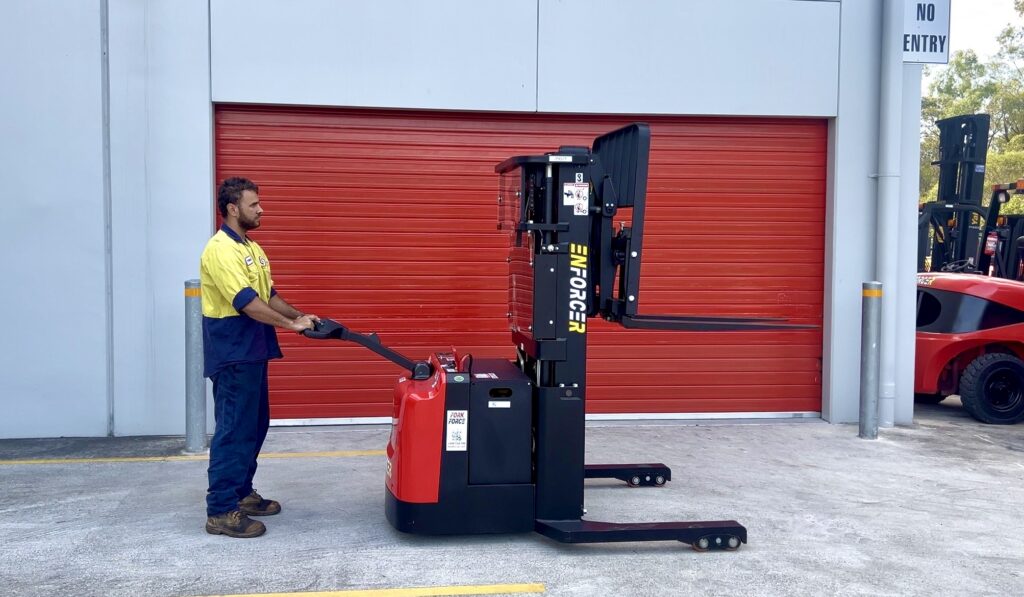
A walkie stacker is a great alternative lifting solution to a standard forklift – combining power and agility with a compact build; however, there are considerations to make. The right walkie stacker depends on the load at working height and the space available for manoeuvring. An unsuitable configuration creates clearance problems or limits the loads you can safely lift. When comparing equipment with Fork Force, your operating requirements provide the starting point for selecting a suitable machine.
For many businesses and warehouse spaces, maximising your inventory capacity is crucial to get the most value out of your space. However, operating within restricted aisle spaces can be challenging and inefficient for standard forklifts due to their bulky size. A walkie stacker is a reliable, smart alternative that gives you the power and efficiency of a forklift with a compact build so you can navigate narrow spaces easily. Best suited for indoor warehouses, walkie stackers lifts and transport pallets while you walk behind or alongside the machine, steering and operating it through a tiller. There are different types of walkie stacker forklifts for your warehouse stocked at Fork Force, and the best one for your operations depends on your handling requirements.
Walkie Stacker Uses and Applications
Pallet stacking, stock transfers and rack replenishment are common walkie stacker uses, particularly when loads travel short distances. A pedestrian stacker has an agile build to easily manoeuvre in tight spaces and is suited to areas where there is enough room for the operator to walk safely alongside or behind the machine – such as warehouses and retail environments.
For frequent trips across a large warehouse, powered travel reduces the physical effort involved – which can keep your team healthier and more efficient. The turning space must also accommodate the pallet or load dimension, including the clearance needed to rotate the load past adjacent racking.
Types of Walkie Stackers
There are different types of walkie stackers which best suit different operations and racking and can be more efficient for your operations. While the pedestrian stacker’s build is more compact, the specific models can impact your application. For example, walkie stackers with support legs can limit how a stacker enters a pallet and approaches racking. The main configurations have different clearance requirements:
- Straddle stackers: The support legs run alongside the pallet and need sufficient space on either side.
- Fork-over stackers: The forks sit above the support legs, so the pallet must accommodate the legs beneath it.
- Counterbalance stackers: A rear counterweight removes the need for forward straddle legs, giving the machine access to pallets and racking where those legs would obstruct entry.
- Walkie reach stackers: The forks or mast extend forward, allowing the machine to access deeper racking from the aisle.
An electric walkie stacker may have powered lifting alone or powered lifting and travel. Powered travel is particularly useful when pallets are moved repeatedly throughout a shift. For the ultimate narrow spaces, our Enforcer walkie reach stacker range includes moving-mast configurations, as well as pantographic reach models for access deep racking systems.
Walkie Stacker Capacity and Lift Height
While compact compared to forklifts, walkie stackers have a capacity from 800kg up to 2T – capable of lifting loads frequently without compromising on performance. However, depending on your load centre and requirements, this can affect the maximum rated capacity – such as loads lifted at height or extended out for deeper racking.
To ensure your unit is suitable for your operations, check your required lift height to ensure the walkie stacker capacity will not compromise the capability of the equipment.
Walkie Stacker Safety and Operator Requirements
While walkie stackers do not require a forklift licence (unless it is a ride-on walkie stacker), it is important to ensure precautions and training are in place so your team and workspace remain safe. Operators need appropriate instruction, training and supervision. Pedestrians and stackers need separate travel paths wherever possible, particularly around blind corners and loading areas. Keep the load low during travel and make sure it does not obstruct your view. Before lifting, check that the pallet is stable and the load is positioned correctly on the forks.
Licensing depends on the machine’s classification and the requirements in your state or territory. Safe Work Australia’s high-risk work licensing guidance outlines the national framework, while your state or territory regulator can confirm the requirements for the particular machine.
Walkie Stacker Buying Guide and Price
Walkie stacker prices are dependent on your exact needs – and can vary based on power type, capacity, and configuration. When choosing the right walkie stacker for your operations, you should consider your working height, your load dimensions and the turning requirements within your aisles.
Daily operating hours and workspace configurations can influence battery selection. Frequent usage may require battery swaps throughout a shift to ensure limited downtime or require suitable charging arrangements to facilitate regular operation.
If you are comparing walkie stackers in Australia, our new and used equipment, long-term hire and Rent-To-Own options give you different ways to acquire a suitable machine. A hire may suit a temporary requirement, while a machine needed for regular pallet handling might prefer outright ownership options – however, it should consider overall purchase costs, servicing and expected operating life.
For an accurate quote, please get in touch with our friendly team of forklift specialists and provide your pallet dimensions, maximum load, racking height and aisle measurements. Your daily operating hours and available charging facilities will help us identify a machine suited to the job.
Speak with Fork Force about a walkie stacker for your racking requirements.
FAQs
Do you need a forklift licence to operate a walkie stacker in Australia?
Licensing requirements depend on the stacker’s classification and your state or territory regulations. Some pedestrian-operated machines fall outside high-risk forklift licensing requirements, but the classification needs to be confirmed with the relevant regulator. Operators still require appropriate training and instruction, even when a high-risk work licence is not required.
Can a walkie stacker unload a delivery truck?
Truck unloading requires a stacker designed for the loading arrangement. The truck-floor height, dock access and surface conditions must suit the machine, and its rated capacity must cover the load. Depending on the lifting requirements, a standard forklift may be more suitable.
What is the difference between a walkie stacker and a pallet jack?
A pallet jack lifts pallets just clear of the floor for transport. A walkie stacker has a mast that raises suitable pallets to storage height, allowing you to stack loads or place them into racking.