
Regulations aren’t the most exciting part about buying and operating a forklift truck, but you will need a licence in many cases to operate one. So, it’s important that you understand exactly what kind of licence you will need.
There are two primary types of forklift licence issued in Australia, the LF Class and the LO Class. If you are not certain which class of licence you need to operate the forklifts in your fleet – or whether you need one at all – then we’ve got a guide that can help you to understand the requirements better.
As well as the question of licencing for walkie stackers, you will also gain a greater understanding of:
- What walkie stackers are
- What they’re used for
- The benefits of using them
- The different kinds of walkie stackers you can buy
When operating any machinery, it’s important that you and your employees are aware of all the regulations regarding that equipment, and that they are fully trained to use it in a safe and efficient manner. Certain licencing is required to operate a forklift truck, but does this apply to less heavy-duty handling equipment such as the walkie stacker?
What licences do you need to operate forklifts in Australia?
Before you can operate a forklift in Australia, you need to make sure you have the correct and up to date licencing. Before you can obtain a forklift licence, you need to be 18 years of age or older, have a solid understanding of the basics of the English language, including non-verbal communication, and be able to provide identification such as a passport or driving licence.
There are two primary types of forklift licence:
LF Class – Forklift truck licence
This is the primary licence type needed to operate a forklift, including counterbalance and reach forklift trucks. This covers all types of forklift other than order picking forklifts.
LO Class – Order picking forklift truck licence
This type of licence is specific to order picking forklifts, including turret trucks. Order picking forklifts are those which require the operator to be seated at an elevated height.
Operating a Walkie Stacker in Australia
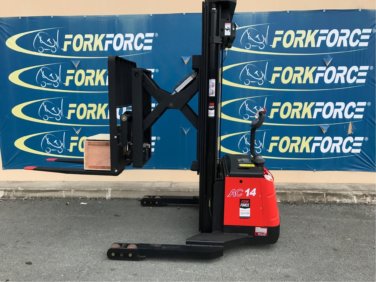
Enforcer 1.4T Walkie Reach Stacker
A walkie stacker is a pallet truck with which the operator walks behind. They are suitable for order picking in warehouses and retail stores, and other tasks such as pallet handling and stacking. They are the ideal solution for smaller loads in workplaces where a full forklift truck is not required. Walkie stackers have average load capacities of up to 1 – 2 tonnes.
As most walkie stackers are operated by walking behind the machinery, a forklift licence is not required to operate them. The exception to this rule is for ride on walkie stackers, which require an LF class forklift licence. In any case, walkie stacker operators must be trained on the controls and safety procedures involved with using the equipment, even when a licence is not required.
Why choose a Walkie Stacker?
Walkie stackers can serve as a great alternative to forklifts in a number of situations, particularly for storerooms or smaller warehouses where material handling needs are less demanding. If load carrying equipment is required for less than five hours per day and is typically used for small to medium-sized loads, then a walkie stacker is a suitable choice.
By choosing a walkie stacker over forklifts, you have the advantage of not requiring a licence to operate the equipment. This means you don’t have to spend as much time and money training employees to use walkie stackers, and more employees may be able to operate them.
Walkie stackers are also a more cost-effective solution for a company’s material handling needs. They’re cheaper to buy than other equipment of this type, and with a choice between manual and electric walkie stackers, you can also benefit from lower running costs as fuel is not required to run these units. As with all electric forklift equipment, this means less noise and air pollution.
Walkie stackers are less bulky than forklift trucks, which makes them highly manoeuvrable and perfect for the small and narrow areas that are typical of storerooms and small warehouses. The compact chassis of walkie stackers also means that they are easy to operate and provide high visibility for the operator.
The different types of Walkie Stackers
Walkie stackers are a great option for many businesses, but there are many different types available, so how do you know which to get? Here are some of the different types of walkie stackers that are available to buy or hire from Fork Force.
Standard walkie stacker
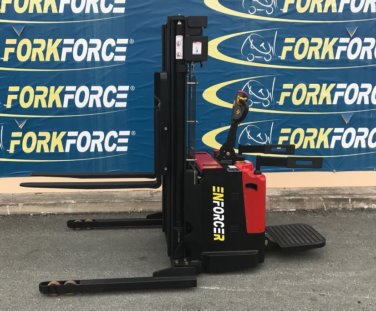
Enforcer 1.5T Walkie Stacker
The most basic form of electric walkie stackers distributes the load it bears with the help of legs beneath the forks. This equipment is ideal for pallet stacking and transformation, and it is the most compact unit available, giving it a tight turning circle that’s perfect for operation in tight spaces. A range of standard walkie stackers are available at Fork Force from Enforcer, Crown, Sumi, Linde, and BT.
Walkie straddle stacker
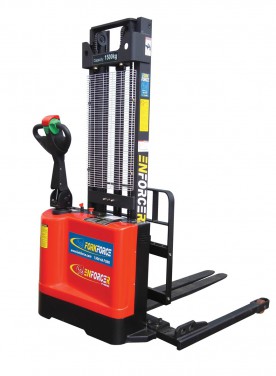
Walkie straddle stackers are the most commonly used walkie stackers in Australia. The straddle legs allow the unit to get closer to the pallet when loading and unloading, providing the perfect solution for small spaces. You’ll find many used straddle stackers available for sale or hire at Fork Force, such as Enforcer.
Walkie reach stacker
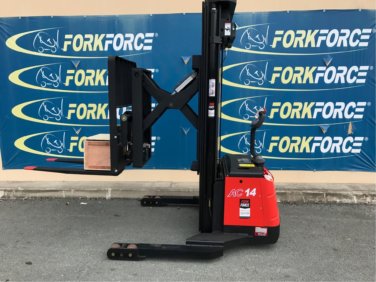
Enforcer 1.4T Walkie Reach Stacker
This type of walker stacker has the added benefit of being able to extend its mast forward to the load, making it easier to reach it. This is a useful feature for applications such as loading and unloading trucks, for example. We have a range of electric walkie reach stackers available to buy and hire, including this brand new Enforcer Battery Electric Reach Stacker that holds up to 2000kg.
For less industrial material handling needs, a walkie stacker is the perfect solution without needing to acquire a specific licence for operating it.
Get in touch with the team at Fork Force to find out more about the new walkie stackers and walkie reach stackers we have. Call Fork Force on 1300 423 675.
